Goods arrive, materials need to be moved, orders have to be prepared, and your team is trying to keep everything running on schedule. Now imagine that some of those goods need to travel from one floor to another.
Suddenly, a simple task can become a challenge.
Moving heavy materials between floors takes time, effort and careful coordination. If your team has to repeat the same process throughout the day, even a small delay can affect the rest of your operations.
This is where an industrial cargo lift can make a real difference.
Rather than making your team work around the challenge of moving goods vertically, a cargo lift helps you plan that movement more efficiently. Whether you manage a warehouse, operate a manufacturing facility or run a commercial building, the right lift can make handling materials between floors a more practical part of your daily workflow.
At SAN-E Industrial, we understand that every facility has its own requirements. The loads you handle, the space you have available and the height you need to cover all influence which solution makes sense for you.
That is why our range includes hydraulic cargo lifts, winch-type goods elevators and dual-chain hoist cargo lifts, each designed for different material-handling needs.
Let’s take a closer look at what we offer and how to decide which one may suit your facility.
What Is an Industrial Cargo Lift, and When Do You Need One?
An industrial cargo lift is designed to move goods, materials and other loads between different floor levels.
You might need one because your warehouse has a storage area upstairs. Perhaps your production process involves moving components between floors. Or maybe your commercial facility needs a more organised way to transport stock from one level to another.
Whatever the reason, the challenge is often the same: how can you move goods vertically without making the process unnecessarily difficult?
An industrial cargo lift gives you a dedicated way to handle that movement.
Instead of treating every transfer between floors as a separate logistical challenge, you can make vertical transportation part of your facility’s regular workflow.
Of course, not every building needs the same type of lift. A facility handling heavy industrial materials may have very different requirements from a commercial space moving lighter goods. That is why it is worth looking at the available options before making a decision.
Choosing the Right Industrial Cargo Lift for Your Facility
When you start exploring cargo lifts, you will quickly notice that there is more than one way to move goods between floors.
At SAN-E Industrial, our range includes three main options: TITAN FORCE hydraulic cargo lifts, WINCHPRO winch-type goods elevators and CHAINFORCE dual-chain hoist cargo lifts.
Each offers a different approach to vertical material handling.
1. TITAN FORCE Hydraulic Cargo Lifts: For Demanding Industrial Environments
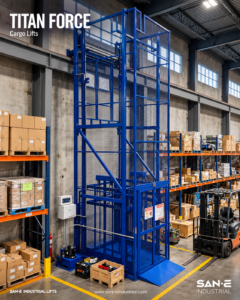
If your facility regularly handles heavy loads, a hydraulic cargo lift may be worth considering.
The TITAN FORCE H-Series is designed for industrial environments such as factories, warehouses, logistics facilities, manufacturing units, automotive facilities and commercial buildings.
Think about the movement of raw materials, equipment or finished products throughout your working day. When these goods need to travel between floors, you need a solution that suits the load, available space and height of your building.
The TITAN FORCE range offers different configurations to accommodate these varying requirements.
Depending on the selected model, capacities range from 1,000 kg to 30,000 kg. Platform dimensions and travel heights also vary by configuration, allowing the lift to be selected according to the needs of the facility.
You can also consider whether an open platform or a fully enclosed arrangement is more appropriate for your application.
What matters most is choosing a configuration that fits the way your business actually works, rather than trying to make your daily operations fit an unsuitable lift.
The TITAN FORCE range may be suitable if you need:
- A hydraulic cargo lift for industrial material handling.
- Capacity options for substantial loads.
- Different platform sizes and travel heights.
- Open or fully enclosed lift configurations.
- A solution for factory, warehouse, logistics or manufacturing environments.
It also lists features such as landing limit switches, a 24V DC safety control circuit, interlocked railings, landing-level digital control panels and a manual lowering valve for use during power loss.
The exact specifications depend on the selected configuration, so it is important to review the relevant model details when planning your installation.
2. WINCHPRO Winch-Type Goods Elevators: A Practical Option for Moving Goods
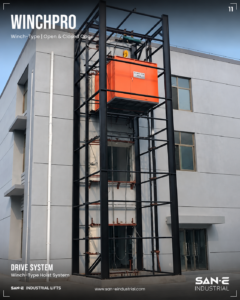
Not every application calls for the same lifting arrangement.
Sometimes, what you need is a straightforward way to move goods between floors in a warehouse, commercial building, construction setting or industrial facility.
That is where the WINCHPRO winch-type goods elevator comes into the picture.
The WINCHPRO with a 500 kg load capacity, along with open and closed cage options.
Imagine a business that regularly transfers boxed products, supplies or other goods between levels. Having a dedicated goods elevator can help make that movement a planned part of the workflow, rather than a task that has to be handled separately each time.
The important thing is to match the elevator to the actual load and working conditions.
If the goods you handle fit within the rated capacity and the selected configuration suits your building, WINCHPRO may be an option worth exploring.
WINCHPRO may be suitable for:
- Warehouses and storage facilities.
- Commercial buildings.
- Construction applications.
- Industrial goods transportation.
- Applications requiring a listed 500 kg load capacity.
As with any lifting system, the intended load, travel height, available space and installation requirements should be considered before selecting a model.
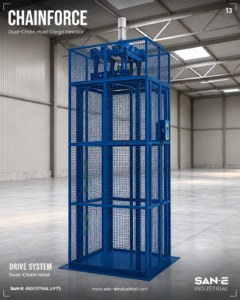
3. CHAINFORCE Dual-Chain Hoist Cargo Lifts: Another Way to Move Materials Between Floors
Now, consider a facility where goods need to be moved regularly, but a different lifting arrangement is preferred.
The CHAINFORCE dual-chain hoist cargo lift provides another option within the SAN-E Industrial range.
CHAINFORCE offers load capacities of 1,000 kg to 1,500 kg, with open and closed cage options. It is intended for commercial, industrial and construction applications.
For a business handling equipment, materials or other goods between floor levels, the choice of lifting system is an important part of planning the movement process.
The CHAINFORCE range gives you another configuration to consider when comparing capacity requirements and the practical needs of your site.
CHAINFORCE may be worth considering if you need:
- A dual-chain hoist cargo lift.
- A listed capacity of 1,000 kg or 1,500 kg.
- An open or closed cage configuration.
- A goods-handling option for commercial, industrial or construction environments.
The right choice will depend on your application and the specifications of the model being considered.
What Should You Look for Before Choosing a Cargo Lift?
Here is something worth remembering: choosing a cargo lift is not just about finding one that can carry the weight of your goods.
It is also about understanding how the lift will fit into your building and your everyday operations.
Before making a decision, take a moment to consider the following.
1. How Heavy Are the Loads You Need to Move?
Start with the basics. What is the typical weight of the goods you transport? What is the heaviest load the lift may need to handle?
Knowing your actual load requirements helps narrow down the suitable options.
Always select a configuration with an appropriate rated capacity, taking the intended application and operating requirements into account.
2. How Much Space Do You Have Available?
The space available for the platform, shaft and installation can influence which cargo lift is suitable.
A lift that works well in one facility may not fit the layout of another. Measuring the available area early can help you identify practical options before moving further into the selection process.
3. How High Do the Goods Need to Travel?
Think about the distance between the loading and unloading levels.
Your required travel height is an important consideration when comparing models. The platform dimensions and installation arrangement should also suit the way goods are loaded and unloaded at each level.
4. Would an Open or Enclosed Design Work Better?
This depends on your goods, building layout and working environment.
An open platform may suit some applications, while a fully enclosed cage or lift arrangement may be more appropriate for others.
SAN-E Industrial’s also includes enclosure options such as perforated sheet and MS mesh.
The perforated sheet provides a protective enclosure while allowing airflow. MS mesh offers visibility and ventilation.
The choice should reflect the practical requirements of your application.
5. What Power Supply Is Available at Your Site?
Your electrical supply is another detail to confirm before selecting a model.
AC power input options of 110V, 220V and 380V. The appropriate supply depends on the selected equipment and site requirements, so confirm the exact specification before installation.
Taking care of these details early makes it easier to compare suitable configurations and plan your project.
Where Can Industrial Cargo Lifts Be Used?
One of the useful things about industrial cargo lifts is that they can support material movement across different types of facilities.
The most suitable system depends on the goods being handled, the building layout and the requirements of the application.
Warehouses and Logistics Facilities
In a warehouse, goods may need to move between storage levels, work areas and dispatch points.
A cargo lift can provide a dedicated route for vertical transportation, helping businesses organise the movement of materials between floors.
Manufacturing and Production Units
Manufacturing processes often involve moving materials, components and finished products from one area to another.
Where production or storage areas are located on different levels, a suitable cargo lift can support the movement of goods between them.
Commercial Buildings
Some commercial facilities need to transfer stock, supplies or equipment between floors.
A goods elevator can provide a purpose-designed way to manage these transfers, depending on the building’s layout and the nature of the goods.
Construction and Industrial Sites
Construction and industrial environments may require goods to be transported vertically as part of daily work.
The choice of lifting system should take account of the load, installation conditions and the specific requirements of the site.
Why Consider SAN-E Industrial for Your Cargo Lift Requirements?
Choosing a cargo lift is an important decision because it needs to work with the realities of your facility.
You may already know the load you need to move, but still be working out the platform size, travel height or type of lift that makes the most sense. Or perhaps you are comparing different lifting arrangements before deciding which direction to take.
SAN-E Industrial brings the industrial division of SAN-E’s engineering experience to material handling and vertical transportation.
The three distinct product ranges: TITAN FORCE hydraulic cargo lifts, WINCHPRO winch-type goods elevators and CHAINFORCE dual-chain hoist cargo lifts.
This gives you different options to explore according to your intended application and load requirements.
Rather than focusing on a single specification, start by looking at the complete picture: what you need to move, how much it weighs, where it needs to go and what your site can accommodate.
Those details will help you identify which product range and configuration deserve closer consideration.
Frequently Asked Questions About Industrial Cargo Lifts
1. What Is the Difference Between a Cargo Lift and a Passenger Lift?
A cargo lift is intended for transporting goods and materials between levels. Its design and configuration should match the loads and conditions of the intended application.
A passenger lift, by contrast, is designed for transporting people. The appropriate equipment depends on the intended use and the applicable installation requirements.
2. What Load Capacities Are Available from SAN-E Industrial?
The load capacities are different across the product ranges.
TITAN FORCE hydraulic cargo lifts have configurations ranging from 1,000 kg to 30,000 kg. WINCHPRO is listed at 500 kg, while CHAINFORCE is listed at 1,000 kg to 1,500 kg.
The available specifications depend on the product and selected model.
3. Can I Choose an Open or Enclosed Cargo Lift?
Yes. The open and enclosed options across the product ranges, although the specific arrangements depend on the model.
Enclosure options listed include perforated sheet and MS mesh. The appropriate choice depends on your application and the configuration available.
4. What Information Should I Prepare Before Enquiring About a Cargo Lift?
It helps to have a few details ready:
- The weight of the goods you need to move.
- The required platform dimensions.
- The travel height between floors.
- The available installation or shaft space.
- Your site’s available electrical supply.
- Whether you require an open or enclosed configuration.
These details provide a useful starting point for identifying a suitable option.
5. Which Industrial Cargo Lift Is Right for My Business?
There is no single answer for every facility.
If you need to handle substantial industrial loads, the TITAN FORCE hydraulic range may be worth exploring. If your application fits the 500 kg capacity listed for WINCHPRO, that range may be relevant. For requirements within the listed 1,000–1,500 kg capacity range, CHAINFORCE offers another option.
The best starting point is to compare your actual requirements with the specifications of each model.
Final Thoughts: Start With What Your Business Needs to Move
Every facility has its own rhythm.
Some need to move heavy materials throughout the day. Others need a practical way to transfer goods between storage levels or keep different work areas connected. The details may differ, but the goal is similar: making the movement of goods a more manageable part of everyday operations.
That is why choosing an industrial cargo lift deserves a little thought before you settle on a model.
Look at your load requirements, the available space, the travel height and the way your team handles materials. Once you understand those needs, it becomes easier to compare the available options and decide what is worth considering.
At SAN-E Industrial, our TITAN FORCE, WINCHPRO and CHAINFORCE ranges offer different approaches to vertical material handling.
Planning a cargo lift for your facility? Visit san-eindustrial.com to explore our industrial lifting solutions and take the next step towards finding an option that fits your requirements.